.png)


What Affects Fencing Installation Price

Understanding What Affects Fencing Installation Price

What affects fencing installation price is rarely a simple answer, and if you've ever been quoted a flat rate and wondered why another job cost twice as much, you're not alone. The reality is that every Melbourne property is different, and the price of a fence reflects that.
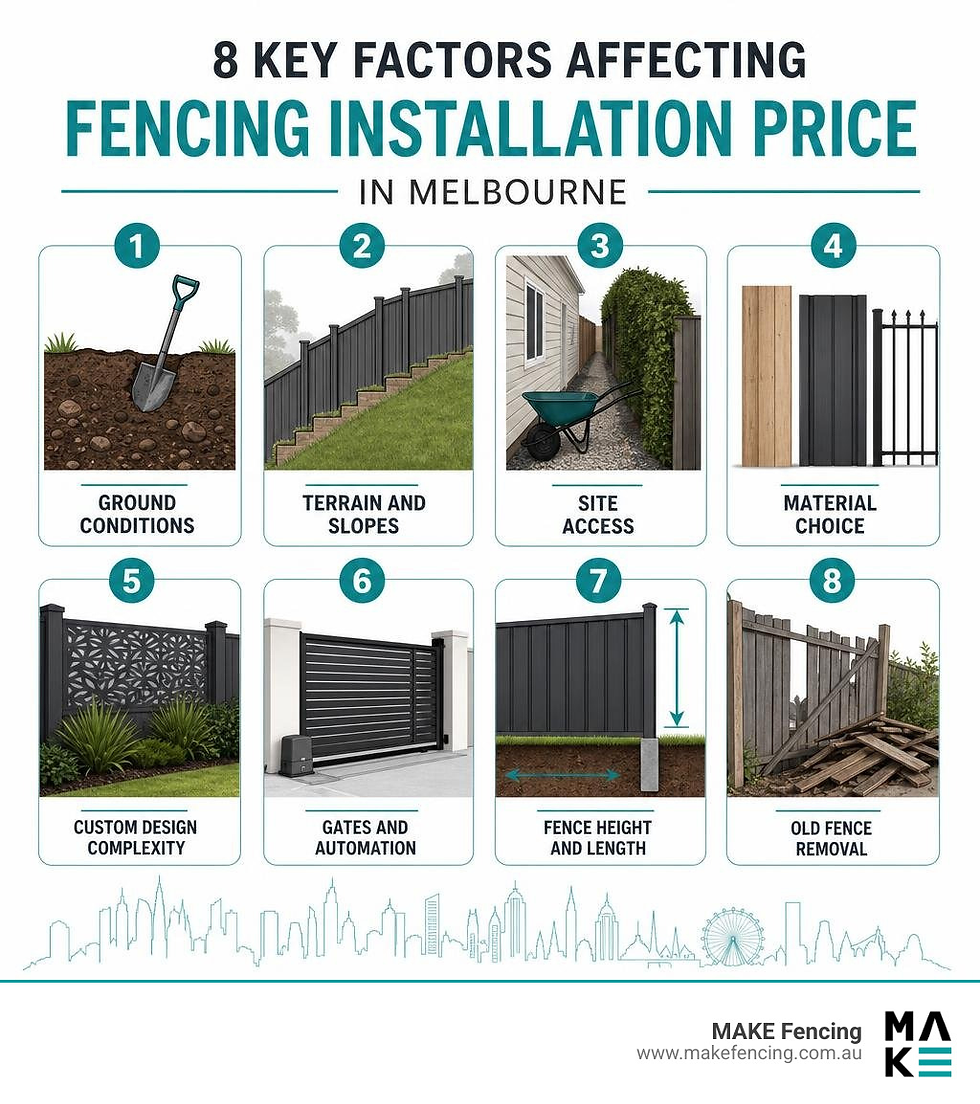
One factor many homeowners don't consider is that the length of the fence can significantly affect the price per metre. Smaller fencing projects often have a higher per-metre cost because many of the fixed expenses remain the same regardless of whether we are installing 10 metres or 100 metres. Every job requires planning, quoting, scheduling, travel, equipment, tools, vehicle costs, site setup, and mobilisation of our installation team. These costs are spread across the total length of the project, meaning shorter fences generally attract a higher rate per metre than larger projects. As the overall fence length increases, these fixed costs are distributed over more metres, often resulting in a lower per-metre installation cost.
Here are the key factors that drive fencing installation costs:
Factor | Why It Matters |
Ground Conditions | Melbourne's basalt clay makes digging harder and increases concrete and labour needs |
Slopes and Terrain | Sloped sites require stepped or racked panels, adding time and complexity |
Site Access | Tight access means equipment can't get in, increasing manual labour |
Material Selection | Timber paling and COLORBOND® steel carry different installation and material costs |
Custom Design Complexity | Feature fencing, decorative metalwork, and bespoke layouts cost more than standard styles |
Gates and Automation | Sliding, swing, and telescopic automated gates are a significant cost variable |
No two properties are the same, and that's exactly why we don't quote a flat rate. A fence on a flat block with easy vehicle access is a very different job to one on a sloped rear boundary in a tight inner-Melbourne suburb with clay soil two spades down.
I'm Jake Bunston, founder of Make Fencing, and over seven years of installing fences across Melbourne I've seen how much what affects fencing installation price can shift from one job to the next. In this guide, I'll walk you through every factor we assess before we price a project, so you know exactly what you're paying for.
Why We Avoid Flat Rates and What Affects Fencing Installation Price Instead
When you see standard, flat-rate pricing advertised, it is often a sign of a contractor cutting corners or planning to hit you with variation costs later on. At Make Fencing, we avoid flat rates because they fail to represent the unique nature of Melbourne properties. Whether you live on a leafy block in Balwyn, a sloping block in Coldstream, or a tight street in Carlton, your property has its own set of challenges.
A flat rate assumes perfect conditions, flat ground, soft soil, and easy access. When a contractor encounters real-world challenges on a site with a flat-rate quote, they are forced to choose between rushing the job or charging you unexpected fees.
We choose a bespoke pricing philosophy instead. We look at the actual site variables, the choice of materials, and the custom design requirements to build a highly accurate, transparent quote. This ensures that you only pay for what your specific job requires, while guaranteeing the highest level of craftsmanship. Understanding the relationship between Fence Cost vs Quality is crucial. Investing in a tailored solution up front means you avoid the structural failures, sagging gates, and leaning posts that come with cheap, flat-rate installations. To get an accurate picture of what your unique project requires, we look closely at all of these variables during our quoting process, which you can read about in our guide on Fence Installation Cost.
Ground Conditions
One of the biggest hidden factors in what affects fencing installation price lies completely underground. Melbourne is famous for its basalt clay soil, which is particularly heavy and compact in northern and eastern suburbs like Coburg, Ivanhoe, and Doncaster.
During the dry summer months, this clay bakes until it is as hard as concrete. In the wet winter months, it becomes sticky, heavy, and incredibly difficult to shift. Digging post holes in Melbourne clay requires heavy-duty machinery, specialised augers, and a lot of manual labour. If a site has rocky floaters, which are large volcanic rocks embedded in the clay, the digging process slows down even further.
This directly impacts the cost of your project. Hard ground requires more labour hours to dig to the correct depth. To ensure your fence remains straight and stable under Melbourne's strong winds, posts must be set deep into the ground with a generous amount of concrete. Skipping this step or digging shallow holes to save time will lead to a leaning fence within a few years. We outline the importance of this structural foundation in our Fence Post Installation Complete Guide, which explains why correct post depth and robust concrete footings are non-negotiable for a long-lasting boundary.

Key Site and Material Factors for Your Melbourne Property
When planning your budget, it is helpful to look at how industry experts view overall project costs. For example, the Realestate.com.au Fencing Guide highlights how site conditions, material choices, and labour complexity work together to shape the final investment of any Australian fencing project. Let us break down how these specific site and material factors apply to your Melbourne home.
Slopes and Terrain
If your property sits on a slope, your fence cannot simply be run in a straight line without custom adjustments. We must use either stepped panels, where the fence drops down in neat steps to follow the incline, or racked panels, where the fence follows the angle of the ground. Both methods require precise measurements, custom cutting, and additional labour to ensure the fence remains secure and visually appealing.
Site Access
Site access is another critical factor. If we are working on a spacious block in Lilydale or Donvale, we can easily bring in machinery to dig holes and transport materials. However, if your home is in a tight inner-city suburb like Fitzroy, Northcote, or Port Melbourne, access is often limited.
When we have to carry heavy timber posts, steel frames, and bags of concrete down a narrow side path or through a pedestrian gate, the entire process must be done by hand. This extra manual handling increases the time required to complete the job, which is a key consideration when planning a Fence Installation Melbourne project.
Material Selection
The materials you choose will play a major role in determining the final cost of your project. Each material has its own unique installation requirements, weight, and structural needs.
Here is a quick comparison of the two most popular fencing options we install across Melbourne:
Feature | Timber Paling Fencing | COLORBOND® Steel Fencing |
Primary Benefit | Classic, natural look; excellent privacy | Low-maintenance; fire-resistant; modern look |
Structure | Timber posts and rails (or optional steel frame) | Galvanised steel posts and channels |
Lifespan | Long-lasting when built with treated pine | Extremely durable; will not warp or rot |
Customisation | Easy to trim, step, and customise on-site | Available in a wide range of pre-finished colours |
For homeowners looking for a classic, natural style, timber paling fencing is a fantastic option. We use high-quality treated timber to prevent rot, and we often build them with a steel frame to ensure they remain straight and strong. If you prefer a modern, ultra-low-maintenance option, COLORBOND® steel is fire-resistant, highly durable, and handles Melbourne's harsh, changing weather beautifully. You can read our detailed comparison of these two styles in our article on Timber vs Colorbond Fencing.
Custom Design Complexity
If you want something truly unique, we also specialise in feature fencing, custom metal fabrication, and modular walls. These custom designs require specialised fabrication, heavier materials, and precise installation techniques, which you can explore further in our guide to Durable Fence Materials.
Gates and Automation
A fence is only as secure as its entry points. Adding gates to your boundary design introduces moving parts, structural reinforcement, and hardware that naturally impact the overall price.
A standard pedestrian gate requires strong, reinforced latch posts to prevent sagging over time. If you require vehicle access, the complexity increases. We design and install custom swing gates, sliding gates, and telescopic gates to suit different driveway layouts.
Integrating automated systems adds another layer of convenience and security. Automated gates require high-quality motors, safety sensors, electrical wiring, and custom programming. While gate automation increases the initial investment, it provides unmatched security and convenience, allowing you to secure your property in suburbs like Brighton or Bentleigh with the touch of a button.
Professional Installation vs DIY Realities
It can be tempting to think about tackling a fencing project yourself to save money. However, the realities of DIY installation often lead to long-term headaches and higher costs down the road.
A professional installation ensures that your fence is perfectly aligned, structurally sound, and built to withstand local soil movement and wind loads. Digging post holes to the correct depth, mixing concrete in the right ratios, and ensuring perfect levels across a sloping boundary requires specialised tools and years of experience.
When mistakes are made during a DIY install, they are highly visible and expensive to fix. Leaning posts, sagging gates, and warped panels often have to be completely demolished and rebuilt by professionals. Before deciding to take on the project yourself, we encourage you to read our guide on Can You Install Your Own Fence to understand the challenges involved, or learn more about the benefits of working with Professional Fence Installers.

Ready to Transform Your Melbourne Property Boundary?
At Make Fencing, we believe that a great fence is an investment in your home’s security, privacy, and street appeal. Because every property from Flinders to Fairfield has its own unique layout, soil profile, and design requirements, we do not offer generic, flat-rate pricing. Instead, we work closely with you to design a custom solution that fits your property perfectly.
If you are ready to secure your property with a beautiful, durable, and custom-built fence, we are here to help. Contact our expert team at Make Fencing today to arrange a detailed, on-site consultation and receive a fully bespoke quote tailored to your property.
Frequently Asked Questions
How does Melbourne's clay soil affect the installation of my fence posts? Melbourne's heavy basalt clay expands when wet and shrinks when dry, which can cause soil movement. To prevent your fence from shifting or leaning, we dig deeper post holes and use highly robust concrete footings to anchor the posts securely into the ground.
Can I integrate an automated sliding gate if my driveway is on a slope? Yes. While sloped driveways make gate installation more complex, we can design custom sliding or telescopic gates with specialised track systems and powerful motors to ensure smooth, safe, and reliable operation on uneven ground.


