


Stop Opening Your Own Gate: A Beginner's Guide to Automatic Gate Installation


When we install an automatic gate, every physical and mechanical component needs to suit the property from day one. Automatic gates are powerful systems that move substantial weight, so the gate frame, posts, hardware, motor, power supply, and safety devices all need to work together.
We work with swing, sliding, and telescopic gate systems, with the right choice depending on driveway layout, slope, available clearance, and the space beside the boundary. Swing gates need clear, level travel through their arc. Sliding and telescopic systems need suitable run-off space and a stable track area.
Site Variables and Ground Conditions for Automatic Gate Hardware
Ground conditions across Melbourne can create structural challenges, particularly where reactive clay soils expand in wet months and contract during dry summers. When we design structural hinge posts or sliding gate track footings, the footing depth, width, and reinforcement need to suit the gate load and the ground conditions. If a post shifts even slightly, the gate leaves can misalign, safety stops can trigger, and latching hardware can jam.
Professional Configuration of Actuators, Motors, and Control Systems
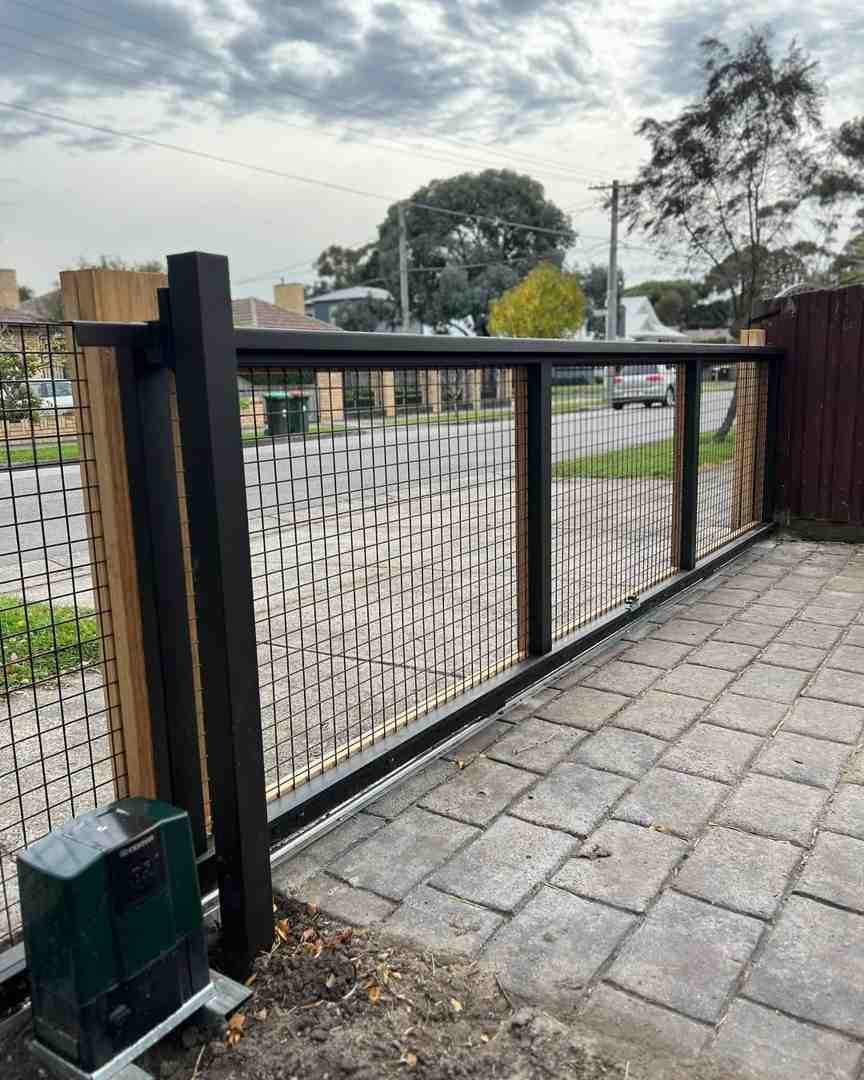
Linear actuator arms and articulated motor arms should be fixed to reinforced structural members, not thin infill or weak rails. Actuator brackets need a secure connection to internal horizontal frame members or reinforced steel mounting plates. Heavy-duty through-bolts, locking hardware, and welded steel plates provide better long-term stability than light fixings.
The control board sits inside a weather-sealed enclosure, positioned away from moving gate leaves and raised above ground level to reduce moisture exposure. Bottom-entry waterproof glands, tidy cable management, and sensible enclosure placement help protect the electronics during Melbourne downpours. Proper mechanical placement is a core part of our approach to gate motor installation.
Power Supply, Solar Configurations, and Wiring Infrastructure
Automated operators rely on a dedicated power supply, usually backed by a 12V or 24V deep-cycle battery system so the gate can keep operating during outages. Power can come from low-voltage mains transformers or integrated solar panel arrays.
Mains Powered Systems: Low-voltage wiring is routed through protective electrical conduit beneath driveways, garden areas, and turf to reduce the risk of cable damage.
Solar Powered Configurations: A correctly matched solar panel and sealed deep-cycle battery can support typical residential gate use, depending on gate weight, daily cycles, shading, and local solar exposure.
High-voltage and low-voltage work must be handled safely in line with Energy Safe Victoria expectations. Neat cable management inside the enclosure also helps keep electric gate motor installation reliable over the long term.
Safety Sensor Integration and Calibration

Safety is non-negotiable. Modern automated entrances need entrapment protection to help prevent vehicles, pets, or pedestrians from being struck. Monitored infrared photo-eye sensors project an invisible beam across the driveway entrance. If an obstacle breaks the beam while the gate is closing, the controller stops and reverses the gate.
Controllers can also monitor motor resistance. If the gate meets unexpected resistance, the system can stop travel immediately. During commissioning, travel limits and soft-start and soft-stop settings are calibrated so the gate slows smoothly before resting against its mechanical stops. This precise setup protects movement across automated gate systems.
Routine Maintenance and System Longevity
A well-maintained gate operator can last for many years. Routine checks preserve alignment and reduce unnecessary wear on electronic drive units.
Maintenance Task | Recommended Frequency | Key Objective |
Hinge and Pivot Lubrication | Every 6 Months | Apply suitable grease to bearing hinges and pivot pins to minimise motor drag. |
Safety Sensor Testing | Monthly | Pass an object across photo-eye beams during a closing cycle to confirm immediate auto-reversal. |
Battery Terminal Check | Every 6 Months | Inspect 12V/24V deep-cycle battery terminals for corrosion and verify charge voltage. |
Track and Hardware Cleanout | Monthly | Clear debris, leaves, and dirt from sliding tracks, rollers, and physical gate stops. |
Enclosure Inspection | Annually | Check weatherproof rubber gaskets, seals, and conduit entries for insect nesting or moisture. |
Structured maintenance helps preserve structural integrity and smooth operation after automatic gate installation.
A Smarter Entrance Starts With the Right Team

Automating a driveway entrance is not a simple weekend project. Gate weight, opening style, post strength, trenching, conduit runs, power supply, access controls, safety sensors, slope, drainage, and daily use all affect the final system.
At MAKE Fencing, we are a family-owned, premium fencing provider in Melbourne with over a decade of experience. We build robust custom gate solutions and integrate leading gate automation hardware for swing, sliding, and telescopic gate systems.
Pricing is fully bespoke because every property is different. The main variables include gate size and weight, swing or track configuration, telescopic requirements, motor capacity, post and footing requirements, ground conditions, driveway slope, power availability, solar suitability, access control options, safety device requirements, cable runs, finish selections, and site access for installation.
To upgrade your entrance with secure, everyday convenience, start your online enquiry through our contact page.


