.png)


The Ultimate Guide to Custom Gates for Your Melbourne Home

Custom Gates That Improve Security and Street Appeal

Custom gates give Melbourne homeowners a practical way to control driveway or pedestrian access while making the front of the property feel finished. The best option depends on your available opening space, driveway slope, security needs and preferred look: swing gates suit many wider entries, while sliding systems can save space where a swinging leaf would obstruct the driveway.
A well-designed gate should also suit Victorian conditions. We consider local weather, reactive clay soils, ground levels, material choice, privacy, and whether you want automation from the start. Fully bespoke pricing reflects the real site conditions, access, slope, design complexity, materials and automation required, helping you consider both the upfront project scope and long-term maintenance and lifespan.
I’m Jake Bunston, founder of MAKE Fencing, and I have spent more than a decade delivering durable fencing and custom gates across Melbourne. We bring practical on-site knowledge, clear communication and careful workmanship to every entrance solution.
Designing and Selecting Custom Gates for Melbourne Properties
Designing a gate requires balancing daily functionality with architectural character. The ideal entryway matches the boundary line of your property, suits the architectural style of your home, and integrates smoothly with existing fencing. Planning a tailored entryway starts with understanding how the opening interacts with foot traffic, vehicles, and the surrounding streetscape.
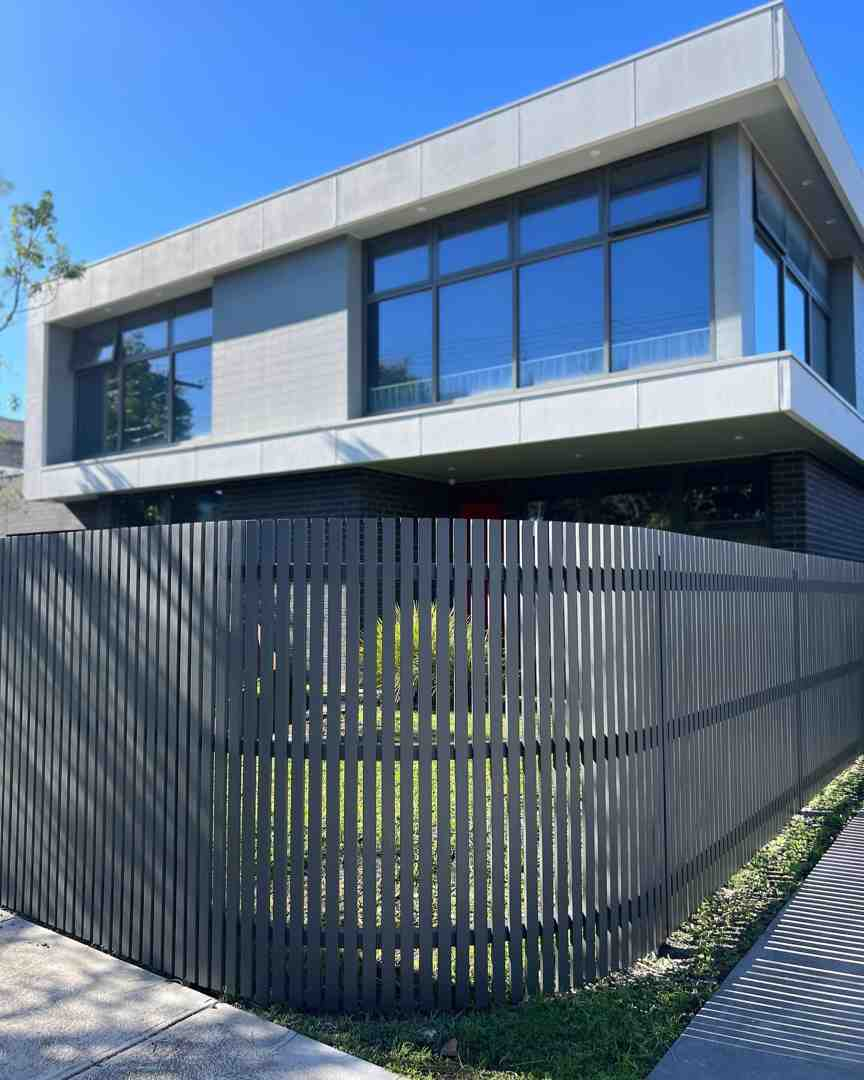
Homeowners exploring custom gate design often look for solutions that enhance safety while creating an inviting facade. Selecting custom entry gates that complement the surrounding architecture ensures a seamless transition between the front garden and the public boundary. For modern estates, incorporating distinctive artistic panels or louvred fencing profiles, as detailed in our guide to custom feature gates, adds an individual touch.
Gate Configuration | Spatial Footprint Required | Best Suited Terrain | Key Advantage |
Single Swing | Full swing arc depth inward or outward | Level driveways or downhill slopes away from swing | Simple mechanical operation and classic look |
Dual Swing | Half swing arc depth of the total opening | Level ground with moderate driveway depth | Reduces stress on individual gate posts |
Single Sliding | Linear runback space along boundary wall | Flat terrain along the fence line | Maximum driveway space preserved inside |
Telescopic Sliding | Reduced linear runback space (stacked panels) | Tight boundaries with limited lateral clearance | Fits wide driveways on narrow frontages |
Popular Configurations: Sliding, Swing, and Telescopic Systems

Choosing the correct opening format depends on how much physical clearance you have along the boundary and within the driveway itself.
Single and Dual Swing Gates: Single swing gates use one wide leaf to secure the entryway. Dual swing gates divide the total opening into two leaves. This split reduces the clearance depth needed in your driveway and distributes weight evenly across both supporting posts. Exploring our guide to swing gate installation provides insight into hinge alignments and swing radii.
Sliding Gate Systems: If your driveway rises steeply behind the entrance or you want to park cars close to the boundary line, sliding mechanisms are the ideal choice. Modern sliding gate systems run along a ground track or operate via trackless cantilever mechanisms, sliding neatly along the boundary fence without cutting into your parking area.
Telescopic Gates: Properties with wide driveway openings but short side boundaries benefit from telescopic gates. These systems use overlapping leaves that stack neatly as they open, requiring significantly less runback space along the front fence.
Material Selection: Steel, Aluminium, and Colorbond Options

The longevity and maintenance requirements of your custom gate depend on the materials you select.
Aluminium Solutions: Marine-grade aluminium is naturally corrosion-resistant, lightweight, and ideal for long spans or automated configurations. It places less load on hinges and automation motors. We build contemporary aluminium gates with premium powder-coated finishes that withstand Melbourne's changing seasonal weather without degrading.
Heavy-Duty Steel: For properties requiring high impact resistance and maximum structural strength, engineered steel frames provide rigidity. Our heavy duty metal gates undergo protective surface treatments prior to powder coating to prevent moisture penetration.
Colorbond Profiles: For total privacy and clean modern lines, welded Colorbond gates are a proven choice. For properties near Port Melbourne, Brighton, Beaumaris, or Flinders, we use Colorbond Ultra Steel to resist coastal salt-air conditions. Homeowners can also choose Mini Orb Colorbond as a textured, contemporary upgrade profile.
Engineering Custom Gates for Sloped Driveways and Melbourne Soil
Melbourne properties across hilly suburbs like Doncaster, Donvale, and Coldstream often present challenging slopes. Installing gates on an incline requires precise engineering so the bottom of the gate tracks smoothly over the ground without scraping or leaving large gaps underneath.
When designing custom metal gates for driveways on slopes, we assess several structural variables:
Bottom-Rail Racking: Fabricating the gate frame out of square so the bottom rail follows the exact slope of your driveway while keeping the top rail and vertical infills level.
Rising Hinges: Using angled offset hinges that allow swing gates to lift slightly as they open inward on an uphill gradient.
Reactive Melbourne Clay Footings: Melbourne's reactive soil expands during wet winter months and shrinks in dry summers. Gate posts require deep concrete footings to keep posts upright and hinges aligned over time.
Structural Post Reinforcement: Heavy gate leaves require heavy-gauge steel posts anchored securely below the ground level to avoid gate sag.
Enhancing Security and Lifestyle with Automated Gate Systems

Adding motorisation transforms your custom gate into a seamless security barrier. You can enter your property at the click of a button without leaving your car during wet weather.
Reliable gate automation depends on selecting a motor matched to the gate's physical weight, width, and daily duty cycle. Our guide to sliding gate motors outlines the differences between low-voltage and high-torque mechanical operators. Installing electric sliding gates provides instant security, especially when integrated into broader residential automated gate packages featuring safety photocell sensors, battery backup systems, and keyless entry pads.
The Bespoke Design and Installation Process for Custom Gates
We follow a structured workflow to ensure your gate looks great and operates reliably for decades.
Initial Concept and Dimensions: We collect your site details and metric measurements to understand the opening width, clearance height, and vehicle access needs.
CAD Drafting: Our design team creates detailed computer-aided design (CAD) drawings. This process takes 2 to 3 weeks, allowing you to review the exact frame layout, infill spacing, and hardware points before production begins.
Metal Fabrication: In our workshop, skilled fabricators cut, assemble, weld, and prepare the metal frames according to Australian fabrication standards, as outlined in our gates and metal fabrication services.
Protective Coating: Steel and aluminium frames receive industrial-grade powder coating for weather resistance.
Site Installation: Our team completes the driveway gate installation, securing the support posts, mounting heavy-duty hinges or tracks, and calibrating automation equipment.
Secure Your Property with a Tailored Entrance Solution
At MAKE Fencing, we take pride in delivering robust, attractive custom gate solutions across Melbourne, from Balwyn, Blackburn, and Glen Iris to Coburg, Carlton, and Fairfield.
Because every driveway is unique, we provide fully bespoke pricing rather than generic estimates. Your project investment is determined by site access, ground conditions such as Melbourne clay, driveway slope, design complexity, material choice, and your preferred automation setup. We focus on low total cost of ownership by using durable materials that minimise long-term upkeep.
Our initial quotations include clear map attachments showing the exact quoted layout of your boundary. Physical property surveys are not part of the standard quoting process. Explore our tailored residential fencing solutions or contact our design team online today to begin planning your entrance. You can also give us a call directly on 0490 255 295 to discuss your gate design with our friendly team.
Frequently Asked Questions About Custom Driveway Gates
Can custom driveway gates be fitted with automatic openers? Yes. All custom gates we design and build can be engineered with reinforced mounting brackets to support automated swing and sliding gate motors, safety sensors, and smart access hardware.
Can you install a custom gate on an uneven or sloped driveway? Yes. We custom-fabricate racked gate frames that follow the natural angle of your driveway or install rising hinge systems for swing setups on uphill grades.
What is the difference between solid privacy infills and open decorative styles? Solid infills, such as Colorbond sheets or tight aluminium battens, block direct street views and improve boundary security, as detailed in our guide on home security gates. Open styles, including widely spaced vertical pickets, maintain airflow, reduce wind loading, and let you see out to the street.
How long does the custom gate design and fabrication process take? Standard CAD design drafts take about 2 to 3 weeks from your initial consultation. Once the design drawings are approved, fabrication and powder coating take several additional weeks depending on the complexity of the materials and hardware requirements.
What maintenance do metal custom gates require? Aluminium and powder-coated steel gates need occasional washing with fresh water to remove surface dirt, especially in coastal areas. Moving parts, such as heavy-duty hinges, guide rollers, and sliding tracks, should be kept clear of garden debris and lubricated periodically.